

Quick answer: The best power bank for travel in 2026 is a USB-C Power Delivery (PD) model between 10,000–20,000mAh, rated under 100Wh so it clears TSA and international carry-on rules with no special approval. For most trips road trips, flights, or national park days a 20,000mAh/20–45W bank covers 3–4 phone charges without adding much weight; laptop travelers should size up to a 65W+ PD bank instead of a bigger battery.
Nothing derails a travel day faster than a dead phone no boarding pass, no maps, no photos, no rideshare. Whether you’re road-tripping between national parks, flying cross-country for Thanksgiving, or working remotely from a café halfway through a trip, a reliable power bank has become as essential as a passport or a phone case. But “best” depends on how you travel: a road-tripper packing a hiking backpack for national parks has different needs than someone flying with just a personal item. This guide breaks down what actually matters capacity, charging speed, and airline compliance so you can pick the right one instead of the biggest number on the box.
How to Choose the Best Power Bank for Travel
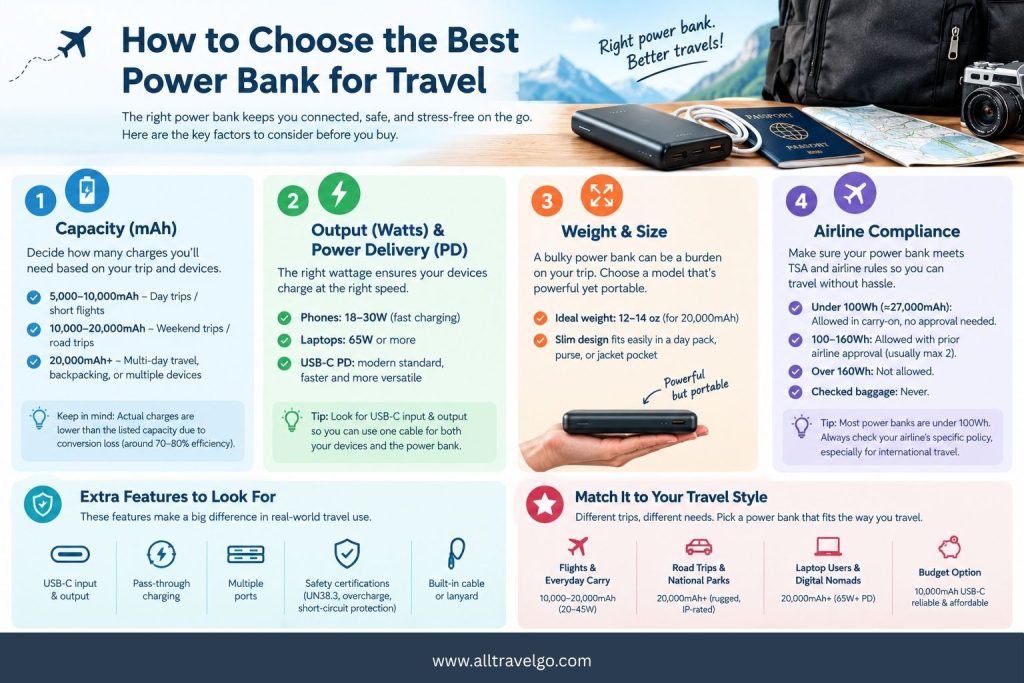
Before comparing models, match the power bank to the trip. Four factors decide whether a bank is actually useful on the road, not just impressive on paper:
- Capacity (mAh): How many charges you’ll realistically get. 10,000mAh covers a day trip or short flight; 20,000mAh+ covers multi-day travel or several devices.
- Output (Watts) and Power Delivery (PD): Phones typically need 18–30W to fast-charge; laptops need 65W or more. USB-C PD is the current standard; it charges faster and lets you use one cable for both the bank and your devices.
- Weight and size: A power bank that’s too bulky ends up left in the hotel room. For carry-on and day-pack use, slim 20,000mAh models in the 12–14 oz range are the sweet spot.
- Airline compliance: This is non-negotiable see the TSA rules below before you buy anything oversized.
Capacity Guide by Trip Type
Trip type | Recommended capacity | Why |
Day trip / short flight | 5,000–10,000mAh | One full phone charge plus buffer; fits in a jacket pocket |
Weekend trip / road trip | 10,000–20,000mAh | 2–4 phone charges, covers a full day without an outlet |
Multi-day trip / national park backpacking | 20,000mAh+ | Charges a phone, earbuds, and a GPS or camera across several days |
Working remotely / laptop on the road | 20,000mAh+ with 65W+ PD | Enough wattage to actually charge a laptop, not just top off a phone |
If you’re planning a longer backcountry stretch, pair your power bank choice with our national park trip cost breakdown and road trip packing list so you know exactly what else needs to fit in the bag.
Can You Bring a Power Bank on a Plane in 2026? (TSA Rules Explained)
Yes, but only in your carry-on, and only under specific capacity limits. According to the Transportation Security Administration, spare lithium-ion batteries, including power banks and phone charging cases, must be carried in carry-on baggage only, and lithium-ion batteries are limited to a rating of 100 watt-hours (Wh) per battery without airline approval.
That covers virtually every consumer power bank. Here’s the breakdown:
- Under 100Wh (roughly 27,000mAh or less): Allowed in carry-on, no airline approval needed.
- 100–160Wh: Allowed with prior airline approval, typically limited to two batteries per passenger.
- Over 160Wh: Not permitted on passenger aircraft.
- Checked baggage: Never. The Federal Aviation Administration requires that if a carry-on bag is gate-checked, all spare lithium batteries and power banks must be removed and kept with the passenger in the cabin.
Most power banks list capacity in mAh, not Wh, so here’s the quick conversion: Wh = (mAh ÷ 1000) × 3.7. A 20,000mAh bank works out to about 74Wh comfortably under the limit. A 27,000mAh bank sits right at the edge of 100Wh, which is why most travel-focused power banks top out around 20,000–26,800mAh.
If you’re flying internationally, double-check your specific airline some carriers (particularly in the Middle East and Asia-Pacific) have introduced stricter in-flight use restrictions on top of the standard TSA/FAA limits, so it’s worth a quick look at your airline’s website before departure.
What to Look for When Buying (Beyond Capacity)
Reviewers and frequent flyers consistently point to a few features that separate a genuinely useful travel power bank from one that ends up unused in a drawer:
- USB-C input and output. Lets you use a single cable to charge both your devices and the bank itself one less cord in your bag.
- Pass-through charging. Charge the power bank and a connected device at the same time overnight, so everything’s topped off by morning.
- Multiple ports. Useful if you’re traveling with a partner or charging a phone and earbuds simultaneously.
- Built-in safety certification. Look for UN38.3 certification (required for air transport) and features like overcharge, short-circuit, and overheat protection.
- A built-in cable or lanyard-style cord. Removes one more thing you can lose or forget at a hotel outlet.
Best Power Banks for Travel, by Use Case
Rather than name a single “best” pick, match your bank to how you actually travel:
Best for flights and everyday carry: A slim 10,000–20,000mAh USB-C PD bank (roughly 20–45W output) covers a full day of phone use, clears the 100Wh threshold with room to spare, and fits in a jacket pocket or day bag alongside the gear from our road trip packing list.
Best for road trips and national parks: A rugged 20,000mAh+ bank with IP-rated (dust/water resistant) housing holds up better to backpacks, dust, and temperature swings than a standard model, worth pairing with a durable hiking backpack built for national park trips.
Best for laptop users and digital nomads: Prioritize wattage over raw capacity; a 20,000mAh bank with 65W+ PD output will actually charge a laptop, whereas a lower-wattage bank of the same capacity won’t.
Best budget option: 10,000mAh USB-C banks from established brands are widely available and reliable for short trips where you just need one or two phone top-offs.
FAQs
How many power banks can I bring on a plane?
TSA doesn’t set a hard limit on the number of power banks under 100Wh; most airlines consider two to three per passenger normal for personal use. Bringing significantly more than that may prompt extra questions at screening.
What size power bank do I need for a week-long trip?
For a week without daily access to outlets, a 20,000mAh+ bank is the practical minimum — it covers a phone, earbuds, and a secondary device like a camera or GPS across several days. For trips with regular hotel or car access to power, 10,000mAh is often enough.
Can I use a power bank during a flight?
Generally yes, to charge your own device in your seat, but some airlines have restricted in-flight use or storage location (for example, requiring the bank stay in the seatback pocket rather than the overhead bin). Check your specific airline’s policy before you fly.
Is a 20,000mAh power bank allowed on a plane?
Yes. A 20,000mAh power bank is roughly 74Wh, well under the FAA/TSA 100Wh carry-on limit, so it’s allowed without airline approval as long as it stays in your carry-on.
Do power banks need to be removed from my bag at TSA screening?
Not usually. Power banks can typically stay in your carry-on through the X-ray scanner, unlike laptops. If the image is unclear or you’re carrying multiple batteries, an agent may ask you to remove one for inspection.
Can I pack a power bank in checked luggage?
No. Spare lithium-ion batteries, including power banks, are prohibited in checked baggage by the TSA and FAA due to fire risk and must stay in the cabin with you.
Planning the rest of your trip? Check out our guides to road trip packing essentials, staying connected with the best eSIM for USA travel, and the best travel apps for road trips and national parks.