
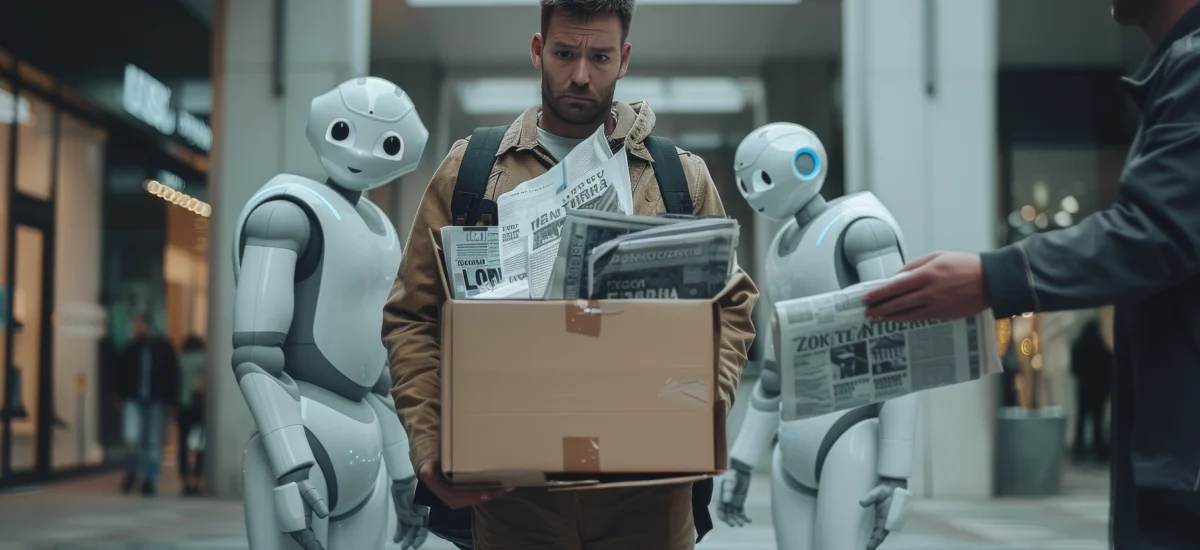
AI-Enabled layoffs are not just a thing of the future, they’re starting to play out in different sectors. As AI infiltrates enterprise systems, automation will remake company operations, job models and workforce structures. Customer service bots and AI-driven analytics work that at one time required large human teams is now performed by machines.
Investopedia has reportedly shared a study suggesting that more than 6.1 million workers are considered to experience high AI automation risk, particularly those in administrative and support positions. This points to the increasing effect AI has on jobs, in industries once thought of as forever steady.
But AI-Driven layoffs are not only about losing jobs. They are a reflection of something even more fundamental an underlying revolution in how work is defined, measured and organized. Firms are moving from fixed job descriptions to skill-based ones, in which humans and technology work alongside each other. It is this change that pivots the story from human versus machine toward a cooperative Human AI relationship.
The question isn’t whether AI will replace workers, but instead how work that of everyone from doctors and lawyers to machinists and waiters will be reshaped for an age of intelligent machines.
Downsizing or Right-Sizing of the Workforce?
Conventional reduction in force targeted downsizing for economic reasons. On the other hand, AI-Driven layoffs are frequently motivated by concepts of efficiency, automation and digitization.
During the beginning of 2026 Amazon shared its next major round of layoffs while doubling down on their AI systems which was amply covered in business specific press. It is representative of a more general corporate movement where AI adoption is included in reorganization strategies.
A Career minds HR study noted that 57% of HR leaders connect future workforce cuts to AI implementation directly, with employees being somewhat oblivious to the dangers of automation. This gulf underscores the different ways that businesses and workers see AI.
But OECD evidence AI is not destroying jobs, but reshaping the structure of labour demand, moving us towards roles centred on analytical, creative and strategic work.
This demonstrates that the effect of AI on employment is as much a creative transformation as it is sheer displacement.
The Myth of Human vs Machine
The human vs machine alarm some readers expressed frustrations that accompany common fears. Academic research out of arXiv looking at millions of job postings finds that AI typically boosts demand for complementary human skills, rather than diminishing entire roles.
This reflects a transition to Human AI collaboration, in which:
- AI handles repetitive tasks
- Humans handle interpretation
- Machines optimize speed
- Humans provide meaning
This even blend of 2 balance components is underlying collaborative intelligence.
AI for Performance Review and Management Systems
AI for performance reviews Another big trend shaping the workplace is AI for performance reviews. AI systems now comb productivity data, workflow design and output metrics to help managers. A peer-reviewed paper on sustainability has suggested that AI in HR is helping to advance consistency, transparency and data-driven evaluation but must be handled ethically in order to avoid bias and surveillance risk.
However, to AI for performance reviews is not replacing HR people, but is supporting them as much as possible and making sure better decision-making when combined with human judgement could build synergy, instead of the theoretical model in Automation dominated.
Career Insurance in Reskilling and Upskilling
The best antidote for AI-Driven layoffs is re-skilling and upskilling. According to a study from Nexford University
- 62% of workers say AI skills lead to increased job security
- 26% of laid-off workers started using AI tools after getting layoff
- Employers value digital and AI fluency more and more
A separate study about the workforce shows that only 18% of work tasks can be totally eliminated by automation, so for most, jobs will transform not vanish. That is why reskilling and upskilling are not choices, but rather survival strategies in the AI economy.
Collaborative Intelligence the New Work Model
Collaborative Intelligence is a method of system where:
- Humans provide creativity and judgement
- AI provides speed and scale
- Technology supports innovation
- People define purpose
This model takes “Human versus Machine” to the next level striking sustainable human AI collaboration. According to Brookings AI is most successful when firms re-engineer processes whereas it fails with role elimination.
Workplace Transformation Table
Work Area | AI Role | Human Role |
Data processing | Automation | Interpretation |
Customer service | AI chatbots | Emotional intelligence |
Performance management | AI analytics | Leadership judgement |
Strategy planning | Data modeling | Decision making |
Creative work | AI assistance | Innovation & vision |
This model enables collaborative intelligence instead of job replacement.
The Psychological Effects of AI-Induced Layoff
AI wreaks havoc and uncertainty in the workplace, as job automation causes anxiety about one’s identity, per new worker-psych research Jobs are not only income they are identity kits. This is why companies who are just about the automation will never last.
Sustainable transformation requires:
- Career transition systems
- Mental health support
- Internal mobility
- Learning ecosystems
- Ethical AI governance
Conclusion
AI-driven layoffs layoffs are not the end of human work they’re the beginning of a world we’ve never imagined! This is the future for those who adapt, learn and evolve. By combining human AI collaboration, reskilling and upskilling and collaborative intelligence, we can turn disruption into opportunity for society.
FAQs
- What is AI-Driven Layoffs?
AI-Based layoffs workforce cuts that have been influenced by automation, AI applications and other digital transformation-related changes.
- How much doom-and-gloom about job-killing robots do you hear on the news, in articles and even coffee shops?
Job transformation, task automation and the creation of new roles. Not just job loss.
- Human-AI teamwork across work go on?
Human-AI teaming empowers machines to take care of routine, low-level work so that humans can concentrate on creativity, leadership and strategy.
- How does AI for performance reviews work in HR?
AI for performance reviews won’t pass the buck it enables data-driven judgements but still uses humans to set fair and ethical standards.